Velocity Layers
A velocity layer is a separate recording of the same note played at a different dynamic — soft, medium, loud. Layering them lets your exported instrument respond to how hard a key is played, instead of just changing volume on a single sample. It's the single biggest step up in realism for most instruments.
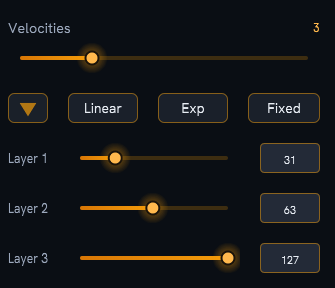
Set the number of layers
The Velocities slider sets how many layers to record per note, from 1 to 9 (default 1). Every layer multiplies your total sample count:
total samples = notes × velocities × round robins
So three velocity layers means three times as many recordings as a single layer. Glance at the ESTIMATED TIME and ESTIMATED SIZE in the summary box before a big run.
Edit individual layer values
Click the expand triangle next to the slider to reveal one editor per layer (Layer 1, Layer 2, …). Each layer has a target MIDI velocity from 1 to 127. These are the velocities Sampling Assistant actually plays when recording each layer.
Presets
Three buttons fill in the layer values for you:
| Preset | What it does |
|---|---|
| Linear | Spreads velocities evenly across the range. |
| Exp | Weights layers toward the quieter end (an exponential curve), giving more resolution where dynamics change most. |
| Fixed | Fills layers from a preset spread of fixed velocity values. |
Linear is the safe default — it distributes the layers evenly. Exp is useful for instruments whose tone changes a lot at low velocities.
How velocity ranges are split
You set the target velocity for each layer; Sampling Assistant works out the range each layer covers automatically, so the whole 1–127 span is divided up with no gaps. Splits land at the midpoint between neighbouring layer values:
- The lowest layer covers from 1 up to the midpoint with the next layer.
- Middle layers run from just above the previous midpoint to the next midpoint.
- The highest layer runs from just above the last midpoint up to 127.
With a single layer, that one sample simply covers the full 1–127 range.
Related
Combine velocity layers with Round Robins for instruments that vary both by dynamic and from take to take.